I never saw myself ending up in a server room.
There I was in the late ’80s, couch surfing at some friend’s uncle’s loft, my hair still carrying the stale cigarette smoke from last night’s club, guitar case propped against my backpack that contained whatever valuables and clothing I had. The punch cards and COBOL classes from college felt like they belonged to someone else’s life story — some alternate-universe version of me who’d taken the sensible path.
Life had other plans.
I still remember the exact moment everything shifted. October 1997, I’m now living in San Francisco. I’m wandering through Circuit City on Market and Van Ness, dodging families test-driving camcorders and teenagers with JNCOs hanging off their hips, crowding around PlayStation demo kiosks. The air carried that distinct electronics-store blend — new plastic, carpet cleaner, and the static electricity of a dozen TVs playing the same CNN clip on loop. Blur’s “Song 2” was blasting from a wall of stereo displays, the woo-hoos bouncing between demonstration speakers while salesmen in those painfully red polo shirts adjusted equalizer settings on receivers that cost more than my monthly rent.
Just that morning, I’d been listening to Brian Jonestown Massacre at a friend’s place in the Mission, passing a joint around his kitchen table while “Straight Up and Down” played from speakers he’d salvaged from an abandoned college radio station. Those fuzzy, droning guitar lines were still stuck in my head as I drifted past rows of car audio equipment that promised to make your Honda Civic sound like the Fillmore.
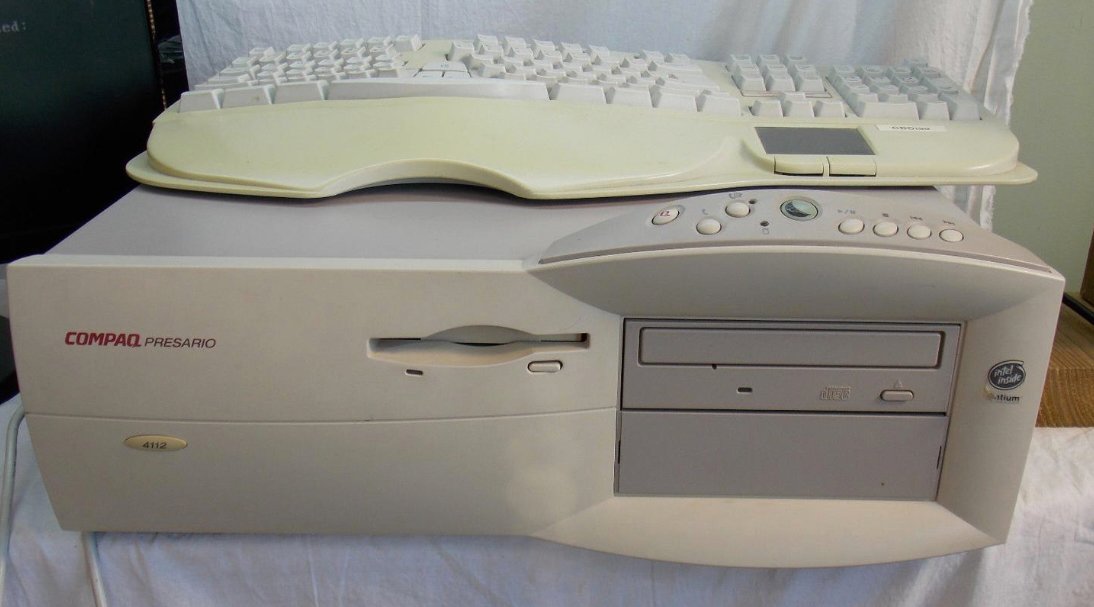
Right there at the front of the store, nestled between the audio section and a display of cordless phones that all looked like props from “Saved by the Bell,” sat a Compaq Presario 4112. Its beige case looked like all the sci-fi movies I watched as a kid. It was the gateway to HAL and “2001: A Space Odyssey,” as well as the haunting 1970 film, “Colossus: The Forbin Project” – that movie that gave me nightmares about computers taking over the world when I snuck downstairs to watch it at 1 AM on Channel 2’s late-night movie.
$1,899. Nearly two months’ rent at that time. It was the computer and monitor package, and it was calling out to me.
“This is an amazing opportunity,” I told myself, already reaching for my credit card. We were starting to use computers more and more at work, and I wanted one of my own so I could tear it apart and learn how they worked. The sales guy kept rattling off specs — 120MHz Pentium processor with MMX technology! 16MB RAM (including 8MB integrated on the system board), expandable up to 72 MB. 1.6GB hard drive! — like he was speaking some religious incantation. I nodded as if I understood what made these numbers impressive, the same way I’d nod when some guitar tech would talk about pickup configurations or tube amplifier specs.

That night, sitting at my office table with the blue monitor glow illuminating my cat as she slept on the couch, something clicked as Windows 95 finished installing. Not the computer — me. There was something eerily familiar about seeing that system come alive. The same part of my brain that once memorized Hendrix solos and worshipped at the altar of Cream was now crafting .bat files and tweaking config.sys parameters. It was like discovering that the language of code had the same satisfying click as finding the perfect chord progression. The rhythm of commands, the syntax patterns – they were verses and choruses in their own strange way.
I found myself diving below the Windows interface into MS-DOS, oddly drawn to the stark black screen with its blinking command prompt. I’d stay up until 3 AM, the blue glow of the monitor replacing stage lights, fingers dancing across the keyboard instead of fretboard, feeling the same rush I used to get working out a complicated bass line. When I finally got that first self-written batch file to automate my system backup, I felt the same triumph as when I’d finally mastered that impossible bass riff from Iron Maiden’s “Run To The Hills” after weeks of trying.
I didn’t know it then, but I’d just bought my ticket for a 25-year ride.
The most surreal moment came about three weeks after I brought that Presario home. I’d installed the bundled software — Quicken, Microsoft Works, and that America Online CD that promised 100 FREE HOURS, the same AOL CD that was being handed out everywhere, filling mail boxes and falling out of magazines like confetti at a digital parade.
That AOL CD felt like a backstage pass to some exclusive digital club. I’d sit mesmerized watching the “You’ve Got Mail” animation, each connection a small victory against technology that seemed determined to test your patience. Remember when downloading a single MP3 was an overnight commitment? When you’d carefully queue up downloads on Napster before bed, praying nobody would pick up the phone and kill your connection? I’d wake up to find whether I’d successfully captured that rare Velvet Underground bootleg or if I’d have to start all over again. We measured our digital lives in kilobytes back then, each megabyte precious as gold.
The machine came with this 33.6 kbps ISA modem — a beige rectangle of possibility that connected through my phone line.
I remember calling my dad that first time. The strange, almost ceremonial process of it all: ensuring no one would need the phone, double-checking the connection, and launching the call software. That otherworldly dial-up screech that sounded like robots arguing — the one you could mute but somehow felt wrong to silence, like it was part of the spell that made the magic work. The same hands that had worn calluses from bass strings were now connecting worlds through plastic and silicon.
“Dad, can you hear me? I’m talking through my COMPUTER,” I practically shouted, as if volume would help the connection. His voice came back through those tiny JBL speakers, slightly tinny and compressed, as if he were talking through a drive-thru intercom from the future.
We both laughed at the ‘magic’, and mused about how amazing technology was — that I was sitting in San Francisco with my coffee in the “No More Bullshit” mug I’d bought at City Lights after a Kerouac binge, he was in his kitchen in New Jersey, and somehow this beige box connected us through the same phone lines we’d always used, but in this entirely new way.
The journey from that night to becoming “Lead Program Manager for IT Infrastructure” wasn’t a straight line. It was a series of small moments that somehow added up to a career:
The first time I fixed a network printer at a temporary job, people looked at me like I’d performed actual magic. It reminded me of the time I rewired my own guitar pickup in the bathroom of a club ten minutes before we went on.
The night I stayed up until 4 AM, teaching myself HTML with a 2-liter bottle of Dr. Pepper and a pack of cigarettes, I created a tragic GeoCities page with animated flaming skull GIFs and an auto-playing MIDI of “Stairway to Heaven.”
The job interview where I bluffed my way through questions about Novell NetWare, my Doc Martens hidden under the table with a cheat sheet taped to the inside of one boot, then spent the weekend at Barnes & Noble with a stack of Novell study guides, cramming as if it were finals week. The same Barnes & Noble where I’d once spent hours in the music section, memorizing guitar tablature from books I couldn’t afford to buy.
The first server crash I experienced — that sphincter-pucker moment, that feeling of stomach-churning dread watching years of company data potentially evaporating while executives hovered behind me, clearing their throats with tense anxiety.
Those server rooms became my second home. Always deliciously cold, always humming with that particular electronic white noise that became as familiar as my own heartbeat. I’d bring in Indian food on weekend maintenance windows, set up shop between server racks with containers of Saag Paneer going cold while I rebooted servers, and lose hours reconfiguring systems while Art Bell was talking about UFOs and Archons on my little radio.
The strange truth about accidentally finding your place is how natural it eventually feels. The progression from “that weird woman who can fix the printer” to the person whose phone rings when the entire system goes down doesn’t happen overnight. It occurs in the accumulation of small victories, late nights, and problems solved when nobody else could figure them out. Not so different from working your way up from crappy opening slots to headlining shows.
I still have a few pieces of ancient technology preserved like personal artifacts. My Iomega Zip drive sits on my shelf next to my first-pressing vinyl of “Marquee Moon” by Television. I can’t bring myself to throw away that box of driver CDs or those ZIP disks, just like I can’t part with the setlists scribbled on bar napkins or that half-working four-track recorder. The Dell Inspiron that survived having wine spilled on it during a particularly wild house party. They’re mileposts marking a journey I never planned to take.
It’s funny how our generation straddled these worlds. We grew up with vinyl records, rotary phones, and a TV with just three channels. Then suddenly, we’re the ones explaining email to our parents and teaching our bosses how not to print out every single document. We weren’t digital natives, but we were digital immigrants who arrived early enough to help build the new world. Maybe that’s why I found such comfort in the logic of technology – it offered structure in a time when everything else was changing so fast. While friends were lamenting the death of rock and roll or the corporatization of the radio, I was discovering new frontiers where creativity still felt limitless.
Sometimes I wonder about that alternate version of me — the one who kept to the original script, who never wandered into Circuit City that day. The one who might still be chasing gigs, living out of a van, guitar case in hand. I don’t know if she’d be happier, but I know she’d have missed something important.
Who would have thought that a reluctant tech student would find her place among the server racks and emergency pagers? Life takes turns you don’t see coming, and sometimes the best ones happen when you’re not even looking at the road.
This is the first in a series of reflections on an accidental 25-year career in technology. Next up: “The First Time I Broke Production: A Horror Story with a Happy Ending.”