There are writers who offer comfort, and then there are writers who offer truth. Alejandra Pizarnik belongs firmly in the second category.
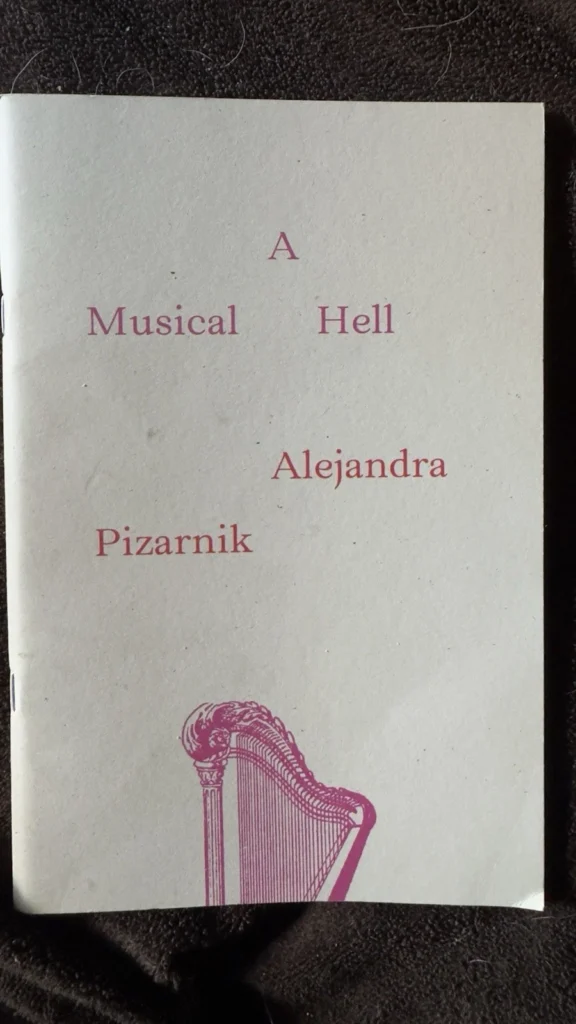
I’m parting with my copy of A Musical Hell — not because it doesn’t matter to me, but because I’m downsizing a collection built over decades. And as I prepare to let it go, I find myself thinking about why books like this shaped the way I see the world.
Pizarnik isn’t an easy read. She’s not supposed to be. But if you’ve ever felt like an outsider in your own life, if you’ve wrestled with the shadow side of existence, if you believe art should disturb as much as it illuminates — then she’s your poet.
WHO WAS ALEJANDRA PIZARNIK?
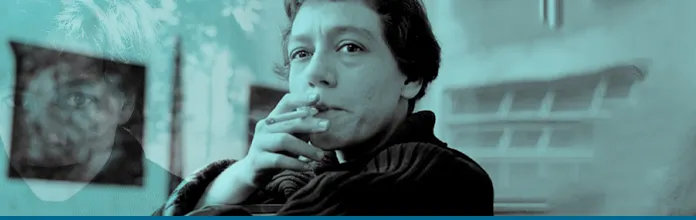
Born in Buenos Aires in 1936 to Russian-Jewish immigrant parents, Alejandra Pizarnik spent her short life grappling with identity, madness, sexuality, and silence. She died by suicide in 1972 at the age of 36, but not before creating some of the most uncompromising poetry of the 20th century.
Her work is fragmentary, surrealist, and obsessed with the breaking down of language. She wrote in the tradition of poets like Paul Celan and Antonin Artaud — artists who believed poetry could only be born from confrontation with the void.
Reading Pizarnik feels like standing at the edge of an abyss. She doesn’t look away. She doesn’t soften. She writes:
“I am afraid of writing. Writing is falling endlessly.”
That’s not a metaphor. That’s lived experience rendered as art.
WHY A MUSICAL HELL MATTERS
A Musical Hell (Extracción de la piedra de locura in the original Spanish) was written near the end of Pizarnik’s life. It’s experimental, theatrical, fragmented — a descent into madness rendered as a strange kind of music.
The Yvette Siegert translation (New Directions, 2013) captures the rawness and intensity of Pizarnik’s language. Siegert doesn’t smooth out the sharp edges. She lets the work breathe in its darkness.
This isn’t a book you “enjoy” in any conventional sense. It’s a book you survive. It works on you the way Kafka’s The Trial or Hesse’s Steppenwolf does — not by resolving anything, but by forcing you to confront what you’ve been avoiding.
THE OUTSIDER TRADITION
When I was a teenager, I found Colin Wilson’s The Outsider — that brilliant study of alienation and creative genius. Wilson wrote about Dostoevsky, Nietzsche, Camus, Sartre, Hesse — those writers who couldn’t reconcile themselves to a world that felt fundamentally absurd.
Pizarnik belongs in that lineage.
She’s asking the same questions Camus asked in The Myth of Sisyphus. She’s exploring the same split self Hesse examined in Steppenwolf. From a Jungian perspective, she’s diving headfirst into the shadow — the parts of ourselves we’re terrified to acknowledge.
And she’s doing it without a safety net.
That’s what draws me to writers like this. They don’t offer easy answers. They don’t promise redemption. They sit with you in the darkness and say, “This is real. This matters. Don’t look away.”
WHY I’M LETTING IT GO (AND WHERE YOU CAN FIND IT) (Feb 2026 update – SOLD)
As I downsize my personal library, I’m making peace with the fact that some books served their purpose at a specific time in my life. A Musical Hell was one of those books. It found me when I needed it, and now it’s time for someone else to discover it.
My copy is pristine — read once, carefully stored in a smoke-free home. If you’re looking for it, I’ve listed it on eBay here. — now sold. It’s the New Directions edition with Yvette Siegert’s translation, in collector-quality condition.
But honestly, whether you buy my copy or find your own, read Pizarnik. Seek out her work. Sit with the discomfort. Let her haunt you.
FINAL THOUGHTS
There’s a line from Pizarnik that stays with me:
“I want to talk to you. But I am afraid of my voice.”
That fear — of speaking, of being heard, of revealing the truth beneath the surface — that’s what makes her work so powerful. She wrote anyway. She spoke into the void anyway.
And decades after her death, her voice still echoes.
If you’ve ever felt that same fear, that same sense of standing outside the world looking in, Pizarnik will recognize you. She’ll meet you in that darkness.
And sometimes, that recognition is enough.
Pizarnik A Musical Hell